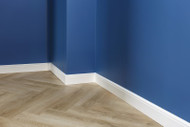
How to choose baseboard height for remodels and new builds
28th Apr 2026
Baseboard moulding isn’t just a cosmetic afterthought. It’s an integral part of your trim package, whether for remodels or new builds. Choosing the right baseboard height helps the trim package feel proportional to the room, flooring, and adjacent casing. This guide walks through the factors that affect height, scale, and coordination in remodels and new builds.
If you are still comparing profiles, review baseboard moulding options by height and profile family before finalizing room proportions.
Why baseboard height matters
Baseboard height has a major impact on the visual appeal of any room. A short base can make walls feel taller, while choosing a taller base will increase the weight at the floor line. The choice you make will change how your overall finish package feels in terms of intent, substance, and architectural style.
Keep in mind that this effect will be even more noticeable once the flooring is installed. The visual activity at the perimeter can be more than you anticipated if you’re going with thick hardwood, layered underlayment, or transition strips. The baseboard can help offset that complexity and keep your room from feeling too busy.
The wall length also plays into baseboard selection. If you’re dealing with long, uninterrupted runs, a tall baseboard can be an excellent option. Conversely, small, segmented walls will read differently. Compact rooms with plenty of doors, cabinets, or other features will make the profile feel heavier if all other things are equal.
Take the time to consider other trim as well. A narrow casing paired with a tall base often comes off as mismatched. Choosing a broader casing with a more moderate base will appear to be more properly scaled. You can’t make these decisions in a vacuum, and our designing with mouldings guide can help you coordinate the overall package.
Proportion also helps improve the perception of the finish, often being as important as the material. Well-matched dimensions often read as more intentional and custom, while poorly scaled profiles can undermine even a good material choice.
Your baseboard moulding height is an integral part of the design in renovations as well as new construction. If you’re dealing with existing heights, flooring, and casing widths, you need to understand the limitations they place on baseboard selection. It’s typically easier to navigate these choices with new construction, as all variables are still in play.
Practical rules of thumb
While situations can vary widely, some practical rules of thumb can help guide your decision-making. For lower ceilings, stick with a slimmer base to avoid compressing the walls. A project with ceilings 8 feet or lower can benefit from a 3- to 5-inch baseboard range, depending on the flooring thickness.
At the shorter end of that range, you should restrain the profile. A plain board or lightly shaped design will read cleaner. Ornamented patterns will clash when used with lower heights. Detail should drop alongside the overall scale to avoid crowding the profile.
Standard rooms around 8 to 9 feet can support bases in the range of 4 to 6 inches. On these kinds of projects, you’ll want to compare baseboards to casing width and floor build-up. Don’t forget to keep your overall goal in mind, whether you’re going for a simple or more traditional aesthetic.
Taller rooms are typically best matched with a larger baseboard moulding. This helps hold the wall visually. For 10-foot ceilings, a 5-1/2- to 7-inch baseboard provides a useful starting range, while rooms with 11-foot ceilings or higher can support bases around 7 to 8 inches or more.
You shouldn’t equip every tall room with the largest profile available. There are many cases where a spare modern interior can call for a leaner base even with tall ceilings. However, renovations with larger casing and crown may need a correspondingly larger-scale baseboard. Ceiling height is just one variable.
Moulding proportion guidance must take a wide range of factors into account to properly compare height and trim relationships. Our Designing with Mouldings guide uses traditional reference points of 5-1/2 inches for 8- to 9-foot ceilings, 6-3/4 inches for 10-foot ceilings, and 8 inches for 11-foot ceilings. In general, your base height, profile complexity, and overall trim weight should increase or decrease together to keep the overall package properly balanced.
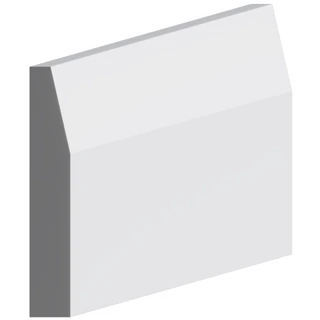

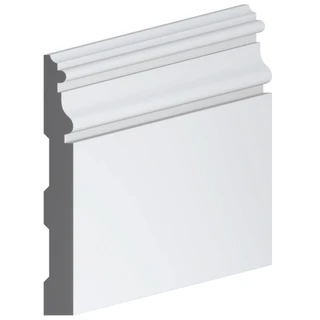
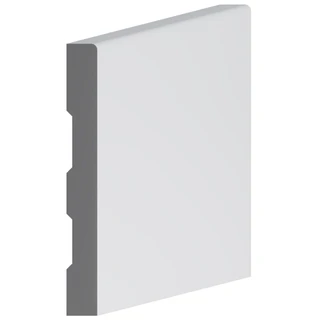
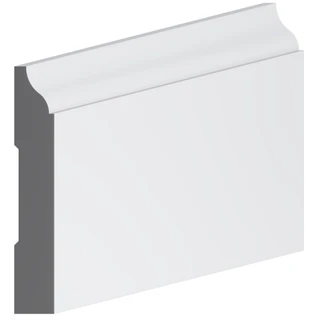
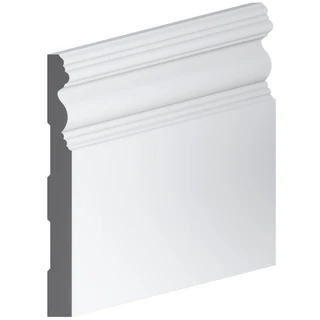
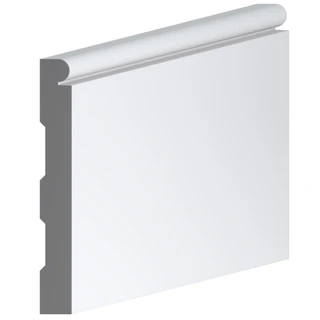
How baseboard height should relate to casing, crown, and flooring
Getting the right look from your baseboard means carefully matching it to the casing. Trim packages often work best when the casing reads lighter than the base. Instead of going for equal visual weight, you may want to combine narrow casing and a simpler profile to balance your baseboard height.
If you’re implementing a tall base, you’ll want a correspondingly wide casing. Increasing the complexity of the casing profile is another option to increase visual weight. Coordinating casing proportions with baseboard and other trim will ensure your project reads like coordinated parts of one whole.
Don’t overlook the importance of crown molding in the overall balance. The weight it adds at the top of the wall can help guide baseboard selection. Rooms without a crown can benefit from a stronger base to help anchor the space. With a substantial crown, a more subtle baseboard moulding may be appropriate, given the existing definition.
However, the relationship isn’t just vertical. Projection also plays a role, and a room with crown, casing, and paneled openings can require a tall base to match that visual weight. Projects with little or no crown may be better suited to a restrained wood baseboard to match the modest tone.
Flooring also factors into adjustments. Even if the wall proportions themselves may call for a smaller base, flooring can add its own visual depth. Wide-plank flooring, engineered boards, underlayment, and transitions create a heavy perimeter. Your base may come across as too slight if you haven't taken this into account.
Consider the overall lower wall area as an assembly that needs to be coordinated. Floor finishes, shoe moldings, transition pieces, casing width, and other details all affect how your baseboard moulding height will look once settled. Finding the right proportion means considering how these elements support each other.
When to modify height or go custom
While there are many stock options available to suit projects of all kinds, some cases call for custom work. If you find a profile that suits your needs but the height is a bit off, modifying the profile to properly match the overall package is an option.
Many types of profiles can be adjusted in height to achieve the proper scale. Projects that require a certain edge detail, bead, or contour can benefit from a fine-tuned base to ensure it sits well with the flooring and casing.
Historical properties are a prime example of projects that call for custom work. The existing trim can have varied proportions that stock packages don’t quite match. Custom wood baseboard molding is one way to preserve continuity without having to redo the entire trim package.
You’ll find similar challenges when dealing with additions and phased remodels, even in newer buildings. Additions can also have varying ceiling heights and floor thicknesses, so an exact match may not be what you need. Instead, you’ll need to carefully customize the trim package to suit a different scale while maintaining style.
No matter what reason you might need custom work, make sure to carefully confirm dimensions before ordering. Evaluate the overall assembly so that what you order actually delivers the results you need.
Find the right baseboard moulding for your project
Choosing the best trim package for your project requires establishing the proper base height to align with the overall proportion. At Mouldings One, we provide a full range of baseboard moulding options. Review baseboard moulding profiles or request a quote if you need a height-modified match for a remodel, addition, or existing trim package.