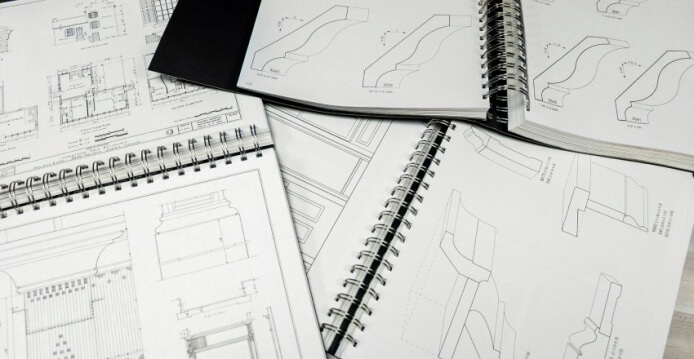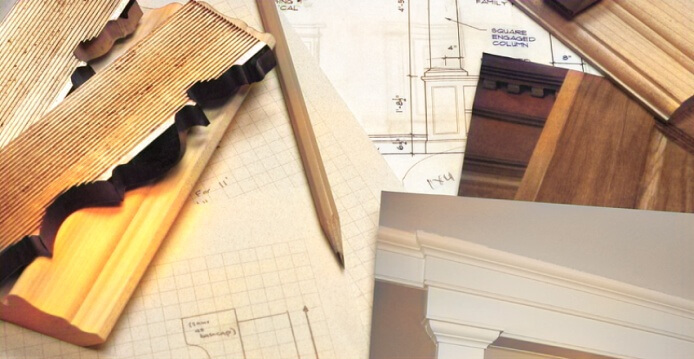
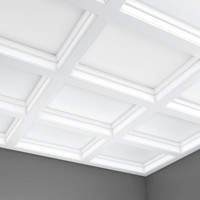


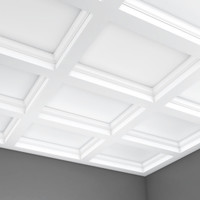
Built-up wood beams add structure, depth, and visual interest to ceilings and walls. Using layered profiles such as S4S stock, crown moulding, or custom elements, these assemblies create architectural definition in both modern and traditional interiors.
What Are Built-Up Wood Beams?
Built-up beams are assemblies constructed from multiple mouldings and S4S boards to create the appearance of solid timber or decorative structural elements. They are commonly used on ceilings or walls to define space, establish rhythm, and add architectural weight without requiring large solid timbers.
Understanding Beams, Coffers, and Girders
The term “beam” is often used loosely, but in architectural and historical millwork, the layout determines the proper terminology.
When shallow beams run in one direction only, they are typically referred to as beams. When beams run in both directions, forming a grid of squares or rectangles, the ceiling is properly described as coffered, with each recessed panel called a coffer.
If smaller members run perpendicular to larger, deeper members, the correct description is beams and joists, with the larger elements acting as the primary beams. Where beams intersect even larger primary members, those larger elements are properly called girders (or, in traditional timber framing, summer beams).
Benefits of Using Built-Up Beams
Layered beam assemblies offer design flexibility, allowing you to tailor size, projection, and profile combinations to suit the scale and character of a space. Assemblies can be simple and modern or more detailed to complement traditional millwork.
Built-up beams are also practical. They can conceal mechanicals, uneven framing, seams, or transitions while providing a clean, finished appearance throughout a room.
Because they are assembled from individual components, built-up beams offer greater control over proportion and detail than a single large profile—making it easier to achieve balanced, intentional results.
Design Applications
- Introduce architectural rhythm by running beams across ceilings.
- Create coffered ceiling systems using beams as the primary framework.
- Use beams and girders to define open-concept spaces.
- Integrate beam assemblies with wall paneling or built-ins for cohesive millwork design.
Coffers, Miters, and Layout Considerations
In traditional coffered ceilings, mouldings and beads intersect and miter at corners to form a continuous grid. This creates clean, intentional junctions between elements and clearly defined modules.
Running elements continuously in one direction while dead-ending the perpendicular members is only appropriate in a beam and joist arrangement, where the deeper beams run through and the smaller joists butt into them.
Choosing Beam Components
Most built-up beams begin with S4S lumber forming the structural box, then incorporate mouldings such as crown, cove, panel mould, or custom profiles for additional depth and detail. Assemblies can be adjusted for height, projection, and complexity depending on room scale and design intent.
How Our Beams Are Supplied
Built-up beam components are typically supplied as running trim in long lengths, not pre-mitered or pre-cut to room dimensions. Layout, miters, and final installation are completed on site.
For coffered ceilings and complex layouts, we recommend determining module sizes in advance. Sharing this information during quoting allows us to recommend appropriate lengths and help minimize material waste.
Explore Beam Assemblies
Browse our examples of built-up beam designs for inspiration. Whether you need a simple modern beam, a traditional coffered ceiling, or a historically inspired assembly, our team can help you select profiles and create a custom solution for your project. Request a quote to get started.