Greek Revival Architecture
The Greek Revival architectural style emerged from a renewed fascination with ancient Greek temples and the classical orders. Following improved access to Greek antiquities in the mid-eighteenth century, architects began studying original sites and measured examples, replacing earlier Roman interpretations with a more literal and archaeologically informed classicism.
Flourishing in the late eighteenth and early nineteenth centuries, Greek Revival represents the final major phase of Neoclassical architecture. The style emphasized clarity of form, strict symmetry, and a deliberate reduction of ornament, relying on proportion and geometry rather than surface decoration.
European and American Influences
In Europe, architects such as Karl Friedrich Schinkel, Claude Nicolas Ledoux, and Alexander “Greek” Thomson explored the expressive power of pure classical form. Their work demonstrated how carefully scaled mouldings could convey monumentality and order without excess.
In the United States, Greek Revival became closely associated with civic identity and democratic ideals. Architects including William Strickland, Thomas U. Walter, and Minard LaFever adapted Greek forms to public buildings, churches, and residences, translating temple architecture into practical American construction.
Greek Revival Interiors and Mouldings
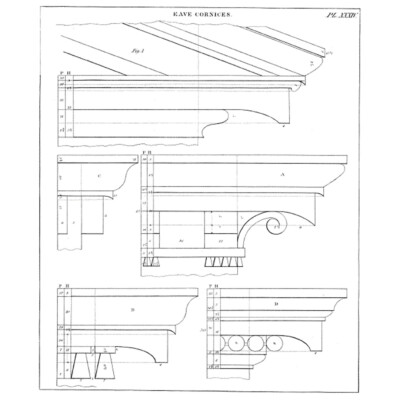
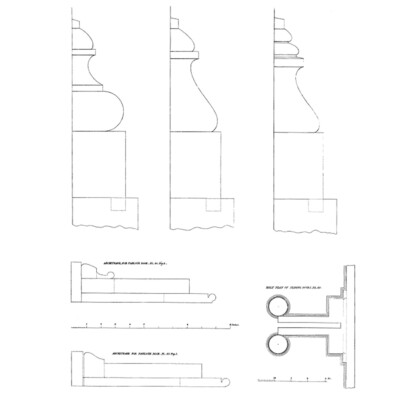
Greek Revival interiors reflect the same disciplined approach as the exterior. Mouldings are typically bold, planar, and structurally expressive, featuring strong architraves, simple cornices, and clearly defined entablatures. Ornament is restrained, allowing proportion and shadow to define the character of a space.
Pattern Books and Lasting Influence
The spread of Greek Revival design in America was driven largely by architectural pattern books and measured drawings. Figures such as Asher Benjamin, Carl Schmidt, and Minard LaFever documented classical moulding profiles and assemblies, providing builders and craftsmen with reliable, historically grounded guidance.
Today, Greek Revival remains a vital reference for traditional architecture and historic millwork. Its reliance on order, proportion, and carefully composed mouldings continues to inform classical design with clarity and strength.