Crown molding sizes explained: Scale, ceilings, and trim package balance
20th Feb 2026
There’s no one-size-fits-all answer to crown molding sizes. Instead, it requires carefully evaluating many aspects of a project to find the right choice. Ceiling height is one of the biggest factors, so it’s one of the first things to look at. Here’s how ceiling height and other factors guide crown molding selection and some tips for common heights.
Quick answers for crown molding sizes
- Ceiling height is an important factor, but understanding the room volume and trim package scale also matters.
- Complex crown molding profiles often feel larger than their actual dimensions would suggest, so plan accordingly.
- Projects that call for a heavier scale can take advantage of built-up assemblies as a practical solution.
- Always validate matching for existing profiles in renovations and additions before locking in molding sizing.
What “size” means with crown molding
Size isn’t just one measurement when it comes to crown molding. Instead, it refers to a combination of factors. While trim can be measured by face size, it’s also important to consider the drop and projection, determining how far the trim extends down the wall and past the ceiling line. Ignoring these measurements can lead to serious mistakes.
Choosing the right size also requires evaluating other parts of the trim package. The ratios between crown size and the casing and baseboard measurements must strike a certain balance. Properly sized crown moldings help establish a clear visual hierarchy and allow the project to deliver a cohesive style.
Drop, projection, and visual weight
Drop, projection, and visual weight are key factors to consider in crown molding sizing. The drop is the vertical distance measured down the wall to the bottom of the molding. This is measured straight up and down, not along the angle of the molding. Two moldings with the same face size can have different drops if their installed angles differ.
Projection is how far the molding projects into the ceiling plane, measured from the wall to the edge of the molding. A larger projection can make a room seem smaller, but it is perfectly suited to large and open spaces. When a molding ends on a wall, a large projection also means that the visible end, the ceiling return, will be more pronounced.
Molding can also be looked at in terms of the spring angle. This is the angle the molding tilts away from the wall, measured between the wall and the inside face of the molding. A common angle is 45° or a close variation, although more extreme angles are possible, and there are many styles that sit flat against the wall or ceiling.
The drop and projection determine the size of the molding, but that isn’t all that defines its visual weight. This perceived size also varies depending on features like relief depth, stacked edges, and flat or curved details. Crowns with lots of breaks and stark shadows often seem larger than those with smooth profiles, even if they’re the same size.
Perceived size in a given room
The right size crown molding differs depending on the specific room. The overall volume of the room has a major impact. Large rooms with long wall runs can look great with heavy crown molding. The ceiling spans such a large area that the molding looks comparatively smaller. For smaller rooms, large trim can make the room seem crowded.
The sightlines of the specific area where the crown molding will be installed also matter. For open layouts, crown molding typically appears as a continuous band. However, areas where crown molding is seen up close can benefit from more edge detail. Comparing style and size with casing and baseboards is a good guide.
Many conditions change how a profile of a given size will look once installed. Dealing with out-of-square corners and complex transitions requires adjusting moldings to suit the specific situation. A smaller projection can help hide these variations instead of turning them into focal points.
The molding finish and the actual lighting in the room also affect perceived size. Painted molding with a high sheen has a stronger visual weight, highlighting breaks and increasing shadow contrast. The grain continuity seen in stained wood can calm down profiles with large dimensions. For stained work, wood crown molding makes species and grain consistency part of the sizing decision, since sheen and grain contrast affect perceived visual weight.
Crown sizing guidance for 8-foot ceilings
With 8-foot ceilings, larger crown molding sizes are constrained by wall height. The goal is to choose molding that accentuates the space without visually lowering the ceiling. A restrained projection can achieve a clean transition while also keeping wall space available for decorations, shelving, and cabinets.
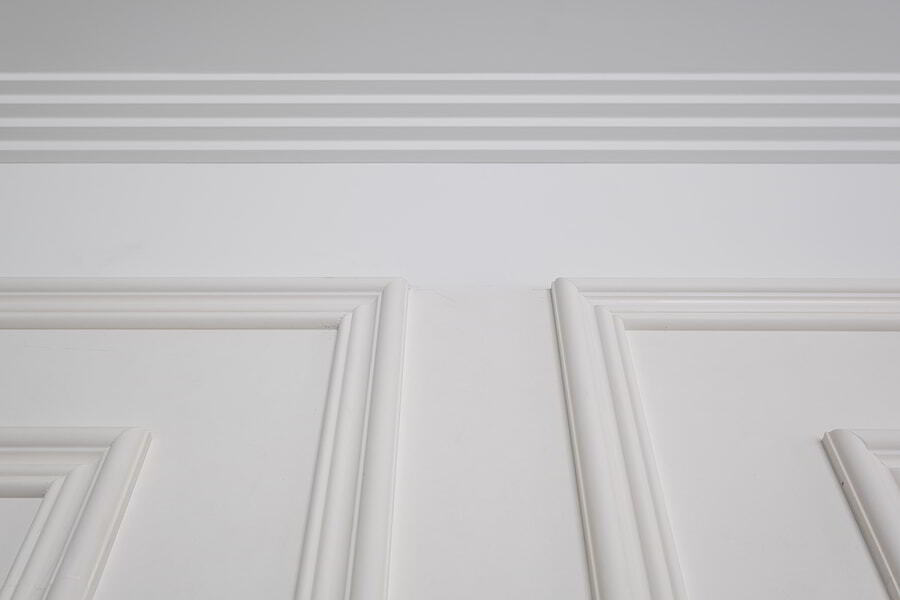
Striking the right balance with casing and baseboards is important in this situation. Large and detailed crown molding can pull attention upward, especially in rooms with narrow casing. This ends up leaving the trim package feeling a bit top-heavy.
Profiles with fewer breaks are a good option for rooms with 8-foot ceilings, as the shadow lines stay tight. If more presence is needed for a given room, increasing the projection slightly is often a better option than going with more detail that could make the visual weight overwhelming.
Crown sizing guidance for 9-foot ceilings
With a bit more height to play with, 9-foot ceilings open up some additional options. Crown molding with a stronger presence can be used without compressing the room. Anything from streamlined profiles to classic styles can be suitable, depending on the architecture of other elements.
Getting the hierarchy across different trim components is important. Moldings with a larger drop are perfectly fine with 9-foot ceilings, but keep in mind that they’ll appear unbalanced if matched with smaller casing and baseboards. There’s also plenty of space to increase visual weight with a profile featuring a deep relief or multiple steps.
Crown sizing guidance for 10-foot ceilings
A project dealing with 10-foot ceilings has to start taking that additional scale into careful consideration. The challenge is that crown molding that’s too light can seem unbalanced and leave the upper wall feeling unfinished. In these cases, profiles with a larger projection and strong shadow definition deliver a more intentional ceiling line.
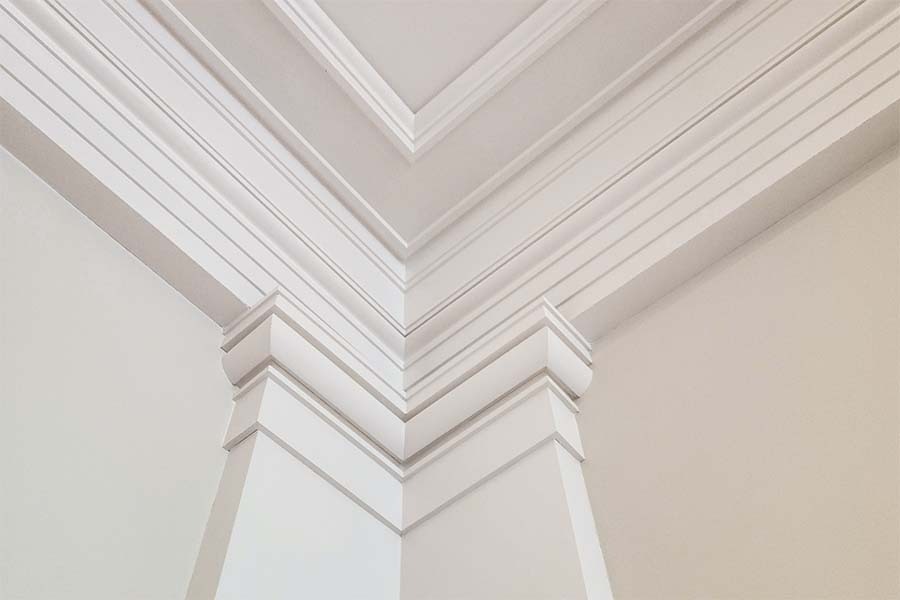
At this scale, many projects take advantage of built-up assemblies instead of an oversized individual profile. Combining multiple pieces achieves the necessary visual weight while making design planning and installation easier. It’s often possible to create these assemblies with stock components.
Properties with 10-foot ceilings often feature beams, coffers, or other components that disrupt ceiling lines. This leads to complex terminations that must be accounted for both in profile style and size. Planning ahead is necessary to ensure smooth installation and a cohesive appearance.
How crown molding styles affect perceived size
The dimensions alone can only say so much about a crown molding. The perceived scale also varies with different crown molding styles. Even if two styles have the same drop and projection, they can have vastly different perceived sizes depending on the style and level of detail.
Compound crown and layered profiles
Combining curves and flats in one section with compound crown profiles creates multiple breaks that enhance visual weight. With a deeper shadow pattern, molding comes across as larger than its actual dimensions and serves as an excellent ceiling transition for a large space.
When using compound profiles, casing and baseboard selection should be proportionate. Going with minimal trim aside from the crown molding leaves the room feeling unbalanced. These profiles are often used in preservation projects to approximate historic styles, but care must be taken to ensure a proper match.
Cove crown molding
Cove profiles feature a single concave curve, limiting shadow breaks due to the lack of edges. That means less relief to highlight, presenting a calm appearance. This achieves a refined transition without adding visual weight, making it a perfect choice for lower ceilings or crowded spaces.
However, cove profiles can also be suited to larger rooms by simply increasing the projection. This occupies ceiling space without busy ornamentation. Paired with simple casing, cove profiles can provide a subtle style that scales well to just about any ceiling height.
Ogee and cyma profiles
The distinctive curves of ogee and cyma profiles create a strong shadow contrast that draws attention. This increases the visual weight, making them feel much heavier than a simple cove profile. Even with similar dimensions, these options will seem larger once installed in the room.
These styles often feature additional elements such as fillets or quarter-rounds. This adds additional break lines and widens the visible face, further increasing visual weight. However, more restrained ogee profiles are also suitable for projects that call for more restrained proportions.
Inclined and minimal profiles
Inclined and minimal profiles with flat faces and minimal ornamentation are a great choice to create clean lines. Fewer breaks mean lower visual weight, making them ideal for smaller spaces. Styles are also available with a larger projection to suit a wide range of spaces.
These styles match well with modern casing thanks to their subdued details. They’re also well-suited to dealing with transitions around cabinets and other bulkheads, delivering a seamless appearance without added visual noise. This maintains continuity, which is vital in modern open interiors.
When matching drives the sizing decision
Sizing to match existing crown molding takes a lot of the flexibility out of the equation. In these cases, getting as close a match as possible is essential. Additions, phased renovations, and other projects can require custom moulding and millwork to maintain continuity with existing trim.
Additions and phased renovations
Getting crown molding right during additions and phased renovations has a major impact on results. With crown molding drawing sightlines along wall runs, hallways, and connections, any mismatch will stand out. Drop and projection need to fit existing molding precisely to maintain a cohesive appearance.
This is particularly important at major breaks. Maintaining the same drop and projection avoids discontinuities in shadows, which are what tend to draw attention in mismatches. If matching isn’t a viable option, choosing a deliberate reset point can be an effective strategy. This helps avoid different crown sizes in continuous sightlines.
Matching with custom moldings
While there are many sizing options for stock moldings, it isn’t always possible to find a close enough match; in these cases, custom crown molding can be the right choice. In these cases, custom moldings could be the right choice. Carefully measuring the size is vital to getting a good match. That means the drop and projection, not just face size.
When ordering custom moldings, it’s also best to define the project scope from the beginning. Identifying all additions or replacements, accounting for terminations, and validating sizes instead of making assumptions allows for a smoother process. Overlooking details until it’s too late could lead to serious trouble for a project.
Choosing the right crown molding sizes for a project
Getting the right crown molding to suit a project doesn’t have to be difficult, but care must be taken. Beyond just drop and projection, accounting for visual weight and style is essential. Mouldings One offers crown molding styles to suit any ceiling height and trim package, and custom molding design is available to match complex project needs.
If you need to replicate an existing profile, custom moulding and millwork can help match drop, projection, and detail.