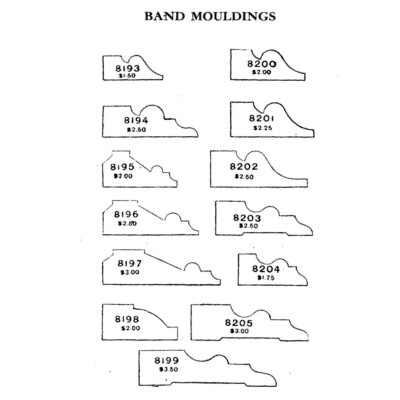
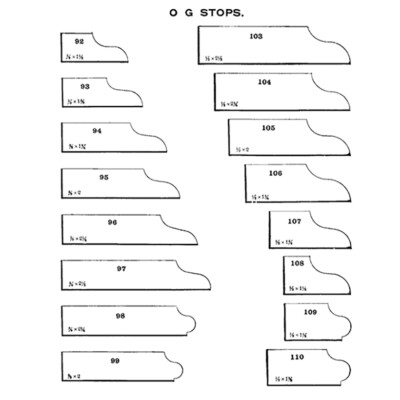
Turn-of-the-century millwork catalogues document a pivotal moment in architectural history, marking the transition from nineteenth-century Victorian ornament to the emerging clarity and restraint of early twentieth-century design. Produced during a period of rapid industrial advancement, these catalogues provided builders, architects, and craftsmen with unprecedented access to standardized moulding profiles and architectural assemblies. By the late nineteenth and early twentieth centuries, advances in milling technology allowed manufacturers to produce complex mouldings with speed, consistency, and precision. Millwork catalogues became essential tools, offering illustrated profiles and assemblies that reflected both lingering Victorian richness and the growing influence of Colonial Revival, Beaux-Arts, and early modern sensibilities. These catalogues capture a moment when architectural taste was evolving. Deeply layered Victorian profiles began to give way to more ordered compositions, while classical proportion and historical precedent remained central to design. Among the most important surviving documents of this period are the Carr & Adams Company Catalogue of 1910 and The Mulliner Catalog of 1893. These publications present measured moulding profiles, assemblies, and architectural details that reflect the practical realities of early industrial production. The Carr & Adams catalogue illustrates the growing sophistication of commercial millwork in the early twentieth century, while the Mulliner catalog represents one of the most comprehensive late-nineteenth-century records of traditional moulding forms. Together, they provide invaluable insight into how architectural detail was standardized, marketed, and constructed during this transitional era. Turn-of-the-century millwork catalogues remain critical resources for restoration, preservation, and historically informed new construction. They offer direct evidence of original profiles, proportions, and assemblies, allowing designers and craftsmen to reproduce period-appropriate work with accuracy and confidence. At Mouldings One, these catalogues serve as reference points for understanding how traditional mouldings evolved at the intersection of craftsmanship and industrial production, preserving a vital chapter in the history of architectural millwork.Industrial Production and Architectural Transition
Historic Millwork Catalogues
Relevance to Historic Millwork Today